Where the AI works.
Every part works from this tender, never from a generic template.
Analysis
Upload the tender documents and the AI reads them cover to cover: the questions, the award criteria and their weightings, the page limits, the format rules, every date. Then it goes further: five analyses run at once, covering the documents, the contracting authority, your competitors, the market and your own company, so what follows is weighed against what this tender actually rewards.
- Summarise the documents and what the client is really asking for
- List the award criteria, with their weightings and the scoring scale
- Catch page limits, format requirements and every date in the timetable
- Check which win themes from your own company profile fit this tender
- Run everything at once on a new project, so your strategy is filled before you start
You stop hunting through the documents for the one clause that decides your bid, and you never start writing blind: by the time you sit down, you know what is scored, how it is weighted and where you are strong. The groundwork that normally eats your first day is already done.
Strategy
The AI proposes the winning angle for this tender, and it is built to tell two things apart: what any competent bidder offers as standard, and what is genuinely distinctive. You set the direction from your own strengths, the client's question or the competitor analysis; from there, every idea is tested against one question: will this score, with this client, in this contract, with this evaluator?
- Propose the strongest angle, or work from yours and combine the two
- Tell standard apart from genuinely distinctive, idea by idea
- Keep every idea honest to this tender: will it score with this evaluator?
- Hold every writing action and every review against the strategy you set
- Follow your angle tender by tender: from the client's question one time, from your proposition the next
A writing tool can sharpen a sentence; it cannot decide what the sentence should be about. With the strategy set first, every paragraph you write has a reason to exist, and that is the difference an evaluator can feel.
Write
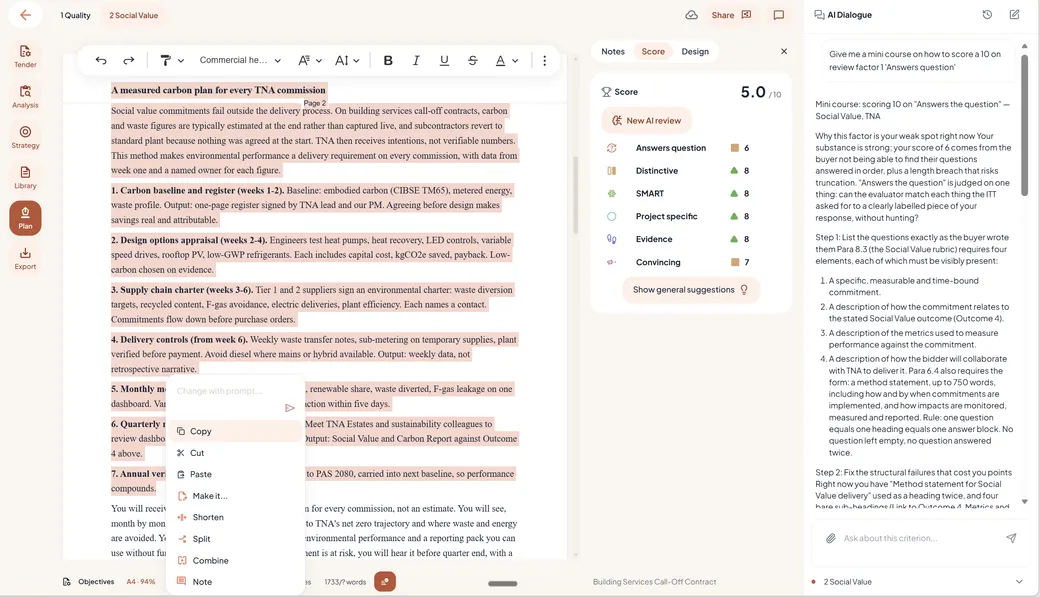
This is where the AI writes with you, criterion by criterion. Every award criterion gets its own Word-like editor, on A4 with the page limit in view, and ten AI operations are one click away: make it SMART, more persuasive, shorter, aligned with the tender's own wording, and more. While you write, the AI checks requirements and format, and warns you when an answer risks being marked "poor or not answered".
- Give every criterion its own editor, on A4 with the page limit in view
- Run expert operations in one click: SMART, more persuasive, shorter, aligned, split, merge, add ideas, rewrite to your instruction
- Offer SCORE-method structure (Situation, Commitments, Outcome, Rationale, Evidence) for the text types tenders keep asking for
- Put passages from your own library next to the question they answer, as evidence
- Warn you about requirement and format risks before an answer can be excluded
You keep writing the way you always have, except nothing in the response is generic. Your text is built from this tender's documents, structured the way evaluators expect and backed by your own evidence. And you stay in charge: the AI suggests, you decide what stays.
Review & score
Before you submit, the review reads your response the way an experienced colleague would, against everything in the project: the documents, the strategy, your own text. It gives an expected score for every criterion on the 6-factor model, using the scale and weighting from the documents, and comments down to word level.
- Score each criterion on the 6-factor model, against the documents' own scale and weighting
- Start with the findings that gain the most points
- Comment down to word level, so nothing is too small to fix
- Check requirements for exclusion risk, and commitments for being SMART and readable
- Test strategy and structure: will the evaluator find every answer where they look for it?
You stop hoping and start knowing. Instead of submitting on instinct, you fix the things that cost the most points while there is still time, and you walk into submission with a realistic score in hand.
Dialogue panel
One conversation, with the whole project within reach. The panel talks to every other part of the workspace: the documents, the analyses, the strategy, your text, the review. A question, an analysis or a fix is never more than a sentence away. It works the way you already work in ChatGPT, except everything it knows is this tender.
- Answer questions about the tender documents
- Run an analysis without leaving the conversation
- Suggest improvements for a single criterion, mid-draft
- Work in the points from a review meeting: paste the transcript and they land in the text
- Assess a colleague's comment on whether it genuinely helps
All the context you carry in your head (this client, this tender, this strategy) is the context the AI works from too. No re-explaining your bid to a generic chatbot: you ask here, and the answer lands on your actual submission.
AI under your control.
The AI proposes; you decide. And the data rules are strict by design.
Humans and AI, side by side. The AI analyses the tender, writes with you and reviews the plan, all in the same workspace.
- Nothing in your response changes without you seeing it.
- Every suggestion can be declined. No tool is compulsory.
- Text goes to AI models that run inside the EU, with zero retention.
- Nothing is kept after processing and nothing is used to train models.